The Art of Which North American People Is Charachterized by Ovals and Rectangles
THE
POPULAR Scientific discipline
MONTHLY
OCTOBER, 1903.
THE DECORATIVE Art OF THE North AMERICAN INDIANS.
COLUMBIA UNIVERSITY.
T HE extended investigations on primitive decorative art which have been made during the last xx years have clearly shown that almost everywhere the decorative designs used by primitive human being do not serve purely esthetic ends, but that they suggest to his listen certain definite concepts. They are not just decorations, but symbols of definite ideas.
Much has been written on this subject; and for a fourth dimension the opinion prevailed that wherever an ornament is explained as a representation of a certain object, its origin has been in a realistic representation of that object, and that it has gradually assumed a more and more conventionalized form, which oftentimes has developed into a purely geometrical motive.[i] On the other hand, Cushing and Holmes accept pointed out the important influence of fabric and technique in the evolution of design, and, following Semper, have called attention to the frequent transfer of designs adult in one technique to another. Thus, according to Semper, forms developed in woods architecture were imitated in rock, and Cushing and Holmes showed that textile designs are imitated on pottery.
The origin of certain designs from technical forms is now recognized as an important factor, and it must therefore be causeless that in many cases the estimation has been read into the pattern. The existence of this trend has recently been pointed out by H.

Fig. 1a Eskimo in Ordinary Dress.
Schurtz[2] and by Professor A. D. F. Hamlin,[3] who has treated in a series of essays the evolution of decorative motives.
In speaking of the process of conventionalization or degeneration of realistic motives, Professor Hamlin says: "Indeed, this degeneration may reasonably be accepted equally suggesting that the geometric forms which it approaches were already in habitual use when information technology began, and that the management of the degeneration was determined by a

Fig. 16. Shamanistic Glaze of Eskimo.
preexisting habit or 'expectancy' (as Dr. Colley March calls it) of geometric course acquired in skenomorphic decoration"[four] (i. e., in a form developed from technical motives). At another place[v] he says: "After having undergone in its own dwelling such serial of modifications, the motive becomes known to the artists of some race or culture through the bureau either of commerce or of conquest. It is carried beyond seas and lands, and in new easily receives notwithstanding another dress in combinations however more incongruous with its original significance. It is no longer a symbol, only an arbitrary ornament, wholly conventional, modified to suit the taste and the arts of the foreigners who have adopted information technology. In many cases information technology undergoes modification in two or more directions, resulting in divergent developments, which in fourth dimension produce as many distinct motives—cousins, equally it were, of each other—each of which runs its ain form independently of the others. This miracle we may call 'difference.' A common cause of divergence is the tendency to digest a borrowed motive to some indigenous and familiar class, usually a natural object, thus setting upwards a new method of treatment quite foreign to the origin of the motive."
I intend to show in the following pages that the same processes, which Professor Hamlin traces past historical show in the art of the civilized peoples of the one-time world, have occurred among the primitive tribes of North America.[6]
Before taking up this subject, I wish to call attention to a peculiar deviation betwixt the decorative style applied in ceremonial objects and that employed in articles of every-mean solar day use. Nosotros find a considerable number of cases which demonstrate the fact that, on the whole, the decoration of ceremonial objects is much more realistic than that of ordinary objects. Thus we find the garments for ceremonial dances of the Arapaho covered with pictographic representations of animals, their sacred pipe covered with human and other forms, while their painted blankets for ordinary wear are more often than not adorned with geometrical designs. Amongst the Thompson Indians ceremonial blankets are likewise covered with pictographic designs, while ordinary wearing apparel and basketry are busy with very simple geometrical motives. On the stem of a shaman's pipe we find a series of pictographs, while an ordinary pipe shows geometric forms. Even among the eastern Eskimo, whose decorative art, on the whole, is very rudimentary, a shamanistic coat has been constitute which has a number of realistic motives, while the ordinary wearing apparel of the aforementioned tribe shows no trace of such decoration (Fig. 1). Perchance the nearly striking examples of this kind are the woven designs of the Huichol Indians of
- Mexico. All their formalism weavings are covered with more or less realistic designs, while all their ordinary wearing-apparel presents geometrical motives. In fact, the style of the 2 is then unlike that it hardly seems to belong to the same tribe (Fig. 2). The same phenomenon may be observed outside of America, as is demonstrated past the deviation in style between the shaman's coat and the ordinary glaze of the Gilt of the Amur River (Fig. 3). We may perhaps recognize the same tendency in the style of decoration of modern dwelling rooms and in that of public buildings. The designs on the stained glass of house-windows are usually bundled in geometrical forms; those of churches represent pictures. The wall decorations of houses are wall papers of more or less geometrical character; those of halls devoted to public uses are generally adorned with symbolic pictures.

Fig. 2. Woven Designs of the Huichol Indians. (After Dr. Carl Lumholtz.)
This difference in the treatment of ceremonial and common objects shows clearly that the reason for the conventionalization of motives can non be solely a technical one, for if so, information technology would act in 1 case every bit well as in the other. In formalism objects the ideas represented are more than important than the decorative result, and it is intelligible that the resistance to conventionalism may be strong; although in some cases the very sacredness of the idea represented might induce the artist to obscure his pregnant intentionally, in society to proceed the significance of the pattern from profane eyes. It may, therefore, be assumed that, if a tendency to conventionalization exists, it will manifest itself differently, even among the aforementioned tribe, according to the preponderance of the decorative or descriptive value of the pattern.
On the other manus, the general prevalence of symbolic significance in ordinary decoration shows that this is an important aspect of decorative art, and a tendency to retain the realistic form might be expected,  Fig. 3a. Ordinary Coat of the Aureate of the Amur River. (After Dr. Berthold Laufer.) provided its origin were from realistic forms. If, therefore, the whole decorative fine art of some tribes shows no trace of realism, it may well be doubted whether their ordinary decorative designs were originally realistic.
The history of decorative design can best be investigated past analyzing the styles of class and interpretation prevailing over a limited surface area. If the fashion of art were entirely indigenous in a given tribe, and developed either from conventionalization of realistic designs or from the elaboration of technical motives, we should expect to find a different style and dissimilar motives in each tribe. The general customs and beliefs might be expected to decide the subjects called for decoration, or the ideas that are read into the technical designs.
As a matter of fact, the native fine art of Northward America shows a very unlike state of affairs. All over the Nifty Plains and in a large portion of the western plateaus an art is found which, all the same local peculiarities, is of a uniform type. Information technology is characterized past the application of colored triangles and quadrangles in both painting and embroidery in a manner which is plant in no other part of the world. The slight differences of styles which occur are well exemplified in the style of painted rawhide bags or envelopes, the so-called 'parfleches.' Mr. St. Clair has observed that the Arapaho are in the habit of laying on the colors rather delicately, in areas of moderate size, and of following out a general arrangement of their motives in stripes; that the Shoshone, on the other hand, like large areas of solid colors, bordered by heavy bluish bands, and an arrangement in which a central field is set off rather prominently from the rest of the blueprint (Fig. four). This difference is so marked that it is easy to tell a Shoshone parfleche that has institute its manner to the Arapaho from parfleches

Fig. 36. Coat of a Shaman of the Gilt of the Amur River.
of Arapaho manufacture. In other cases the about characteristic deviation consists in the identify on the parfleche to which the design is applied. The Arapaho and the Shoshone never decorate the sides of a bag, just its flaps, while the tribes of Idaho and Montana always decorate the sides. Another peculiarity of Arapaho parfleche painting, as compared to that of the Shoshone, is the predilection for two right-angled triangles continuing on the aforementioned line, their correct angles facing each other—a motive of common occurrence all over the southern part of the Plains and in the southwestern territories; while the Shoshone by and large place these triangles with facing astute angles.
| | ||
| Arapaho. | Shoshone. | |
| Fig. 4. Painted Rawhide Bags. (After A. L. Kroeber and H. H. St. Clair.) | ||

A detailed study of the art brings out many pocket-size differences of this sort, although the general type is very uniform.
Certain types of designs are and so much alike that they might belong to one tribe as well every bit to another. A serial of moccasins of the Shoshone, Sioux and Arapaho (Fig. 5) will serve equally a good example. The characteristic forms of all of these are a cross on the uppers, connected with a bar on the instep, from which arise at each end 2 brusque lines. These designs are then complex that patently they must take bad a common origin. Information technology is of great importance to note that nevertheless the explanations given by the various tribes arc quite dissimilar. The design is interpreted by the Arapaho every bit the morning star; the bar on the instep, as the horizon; the brusque lines, as the twinkling of the star. To the heed of the Sioux the design conveys the idea of feathers, when applied to a woman's moccasin; when found on a man's moccasin, it symbolizes the sacred shield suspended from tent-poles. The identical blueprint was explained by the Shoshone

Fig. v. Moccasins; A. Shoshone; B. Sioux; C. Sioux and Arapaho.
US signifying the sun (the circle) and its rays; but also the thunder-bird, the cross-arms of the cantankerous evidently being the wings; the office nearest the toe, the tail, and the upper part, the cervix with two strongly conventionalized heads attached. If these are the ideas conveyed by this design to the weavers, it is clear that they must have developed after the invention or introduction of the design; that the pattern is primary, the thought secondary, and that the thought has zero to do with the historical evolution of the design itself.
It may exist well to give a few additional examples of such similarity of design and difference of symbolism. One of the typical designs of this area is a cantankerous to the ends of which deeply notched squares are fastened (Fig. G). Dr. Kroeber[7] received the following explanation of this design from an Arapaho: the diamond in the heart represents a person; the four forked ornaments surrounding it are buffalo hoofs

Fig. 6. Legging with Young man Embroidery.
or tracks. Dr. Wissler found the design on a pair of woman's leggings of the Sioux. In this instance the diamond-shaped centre of the design represents the chest of a turtle; the green lines forming the cross indicate the four points of the compass; the forked ornaments symbolize forks of trees struck past hailstones, which are indicated past small white rectangles. Mr. St. Clair came across the same pattern among the Shoshone, where it was establish on a cowhide bag. The primal diamond was interpreted as the sun and clouds; the notched designs were explained as mount-sheep hoofs. There is a certain similarity in this case between the explanations given past the Arapaho and those of the Shoshone, while the Sioux connect ideas of a different type with the design.
Such differences of interpretation are also found on painted designs. The Shoshone sometimes imagine they see a battle scene in the squares and triangles of their parfleche designs. The square in the center of Fig. 7 was explained to Mr. St. Clair as an enclosure in which the enemy was kept by a besieging political party, represented by the marginal squares. The narrow fundamental line is the trail by which the enemy made practiced his escape. Many others stand for geographical features, such as mountains and valleys. Such geographical ideas are represented on some Arapaho parfleches, while others exhibit a more than circuitous symbolic significance. Battle scenes, however, are non found in interpretations given by the Arapaho.
The similarity of complex designs, combined with dissimilarity of estimation, justifies a comparison of simpler forms. These might be believed to take originated independently; hut the sameness of the complex forms proves that their component elements must take had a common origin, or at least have been assimilated past the aforementioned forms. One of the striking examples of this kind is the cross. Among the Arapaho it  Fig. 7. Shoshone Parfleche Design. signifies nearly invariably the morning star. To the mind of the Shoshone it conveys the idea of barter. The Sioux recognizes in it a man slain in boxing and lying flat on the footing with arms outstretched. The Thompson Indians of British Columbia recognize in it the crossing trails at which sacrifices are made.
The simple straight scarlet lines with which skin bags are decorated are another adept instance. A specimen was collected by Dr. Kroeber among the Arapaho (Figs. 8a and 8b) in which he explains the stripes on the beaded blueprint on the narrow sides and on the flaps of the bag every bit army camp-trails; the shorter transverse stripes intersecting these longitudinal lines, equally ravines, that is, camping-places. On the front of the bag the horizontal lines of quill-piece of work, which resemble the lines on buffalo-robes, are paths. Bunches of feathers on these lines represent buffalo-meat hung up to dry. Adjoining the bead-work are small tin can cylinders with tufts of red hair; these represent pendants or rattles on tents. Mr. St. Clair obtained the post-obit explanation of a Shoshone purse of almost identical blueprint: The porcupine-quill work on the front end of the handbag represents horse-trails. The blood-red horsehair tassels at each side are horses stolen by people of 1 hamlet from those of another, the villages existence represented past the bead-work at the sides of the bag. The bead-piece of work on the flap represents the owners of the horses indicated by the horse-pilus tassels on the flap. Among the Sioux the same design is used in the puberty ceremonial, and symbolizes the path of life.
It must not be believed that the interpretation of a certain motive, or even of a circuitous figure when used by the members of one tribe,
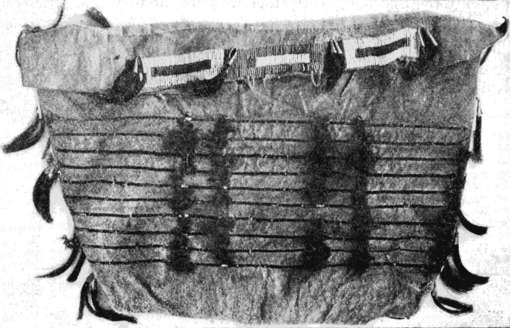
Fig. 8a. Skin Purse of the Arapaho. (After A. L. Kroeber.)
is always the same. Equally a affair of fact, the number of ideas expressed by it is ofttimes quite varied. We discover, for case, the birdbrained triangle with enclosed rectangle (Fig. iv) explained past the Arapaho as the mythic cave from which the buffalo issued,  Fig. 8b. Side of Arapaho Bag. as cattle-tracks, every bit a mount, cloud, brush hut and tent; an acute triangle, with small triangles attached to its base, every bit a bird-tail, frog, tent and bear-human foot.
Nevertheless the explanations given past various tribes prove peculiar characteristics in which they differ from those of other tribes. The explanations possess no less a fashion of their ain than the art itself. Triangles are explained every bit tents by all the tribes, and mountains or hills grade a prominent feature of their descriptions; just among the 3 tribes mentioned only the Sioux run into wounds, boxing scenes with moving masses of men, horses, the pursuit of enemies, the flight of arrows, in their Conventional designs; just the Shoshone encounter in them pictures of forts and stones piled up in memory of battles; but the Arapaho recognize in them prayers for life directed to the morning star.
Nosotros observe, therefore, that in this surface area the aforementioned fashion of art is widely distributed, while the mode of explanation differs materially among its various tribes.
It may be worth while to review briefly the distribution of the fashion of art here discussed. On the whole, it is confined to the Plains Indians, due west of the eastern wooded area. Information technology would seem that it has been carried into the plateau region rather recently, where, however,
| | ||
| Fig. 9. Decorative Motives of the Pueblo Indians. (After Dr. W. F. Fewkes.[viii]) | Fig. 10 Woven Purse of the Nez Percés. | |

information technology has afflicted almost all the tribes east of the Cascade Range and of the Sierra Nevada. We find the acute triangle with small supporting triangles, and the obtuse triangle with enclosed rectangle, in the feature arrangement of the parfleches, on a bag of the Nez Percés (Fig. ten) collected by Dr. Livingston Farrand. At get-go glance, the art of the Pueblos seems quite dissimilar from the one that we are discussing here; only I believe that an intimate clan of the two may be traced. The old pottery described by Dr. Fewkes, for instance, shows a number of the peculiar triangle and foursquare motives which are then characteristic of the art of the Indians of the Plains. The same triangle with supporting lines, the same triangle with the enclosed square (Fig. 10), is found here. Information technology seems very evidently to my heed that the transfer of this fine art from pottery to embroidery and painting on flat surfaces has brought about the introduction of the triangular and rectangular forms which are the prime characteristic of this type of art.
In the prehistoric art of the northern plateaus, in California, on the Due north Pacific coast, in the Mackenzie Basin, in the wooded area of the Atlantic coast, nosotros find styles of art which differ from the art of the Plains, and which have much less in common with Pueblo fine art. Therefore I am inclined to consider the art of the Plains Indians in many of its traits equally developed from the fine art of the Pueblos. I recall the general facts of the culture of these tribes are fairly in accordance with this notion, since it would seem that the complex social and religious rites of the southwest gradually become simpler and less definite as nosotros proceed northward. If this opinion regarding the origin of the art of the Plains is right, we are led to the decision that the tent with its pegs is the same class in origin every bit the rain-clouds of the Pueblos, and then that the telescopic of interpretations of the same form is all the same more enlarged. Under these atmospheric condition, we must conclude that the interpretation is probably secondary throughout, and has become associated with the form which was obtained by borrowing. With this nosotros are brought face to confront with the skeuomorphic origin of the triangular design from basketry motives, which has been so much discussed of recent years.
The so-called 'quail-tip' design of California is another example of the continuous distribution of a motive over a wide area, the occurrence of which in the outlying districts must be due to borrowing. The characteristic characteristic of this pattern, which occurs in the basketry of California and Oregon, is a vertical line, suddenly turning outward at its terminate. This motive occurs on both twined and coiled basketry, and with many explanations.[ix] In some combinations it is explained as the lizard's foot (Fig. 11, a, b), in others every bit the pine cone or the mountain (Fig. xi, c). The gradual distribution of this motive over a wide area can best be proved in this case past a comparing with the distribution of the technique in which it is applied. The design occurs all over cardinal and northern California. On Columbia River information technology is found on the Klickitat baskets. These are of the peculiar imbricated basketry which is made from this indicate on, due north. While the designs on imbricated basketry constitute in British Columbia are of fi peculiar character, the Klickitat baskets of the same make (Fig. 11, d) have the typical California designs which too occur on the twined bags of this district (Fig. 11, c).
Thus nosotros find, not only that the distribution of interpretations and that of motives do not coincide, but also that the distribution of technique does not hold with that of motives. I think we can too demonstrate that the limits of styles of interpretation in some cases overlap the limits of styles of art. We accept seen that on the Plains the fashion of art covers a wider expanse than the manner of interpretation. It would seem that in other regions the reverse is the case. For instance, the style of art of the Nootka tribes differs very much from that of the

Fig. 11. Baskets from the Pacific Coast. a, b, Pit River California: c, Maidu, California; d, Klickitat, Washington; due east, Nez Percés, Idaho, (a, b and c after Dr. Roland B. Dixon.)
Kwakiutl. Although both use animal motives, the Nootka use very trivial surface ornamentation consisting of combinations of feature curved lines, which play an of import office in Kwakiutl art., and which serve to symbolize various parts of the body. Nootka art is more than realistic and at the same fourth dimension cruder than Kwakiutl art. The ideas expressed in the art of both tribes, however, are practically the aforementioned. In the southwest nosotros notice that the civilization of the Pueblos has securely influenced the neighboring Athapascan and Sonoran tribes, while at the same time the decoration of their basketry bears a close relation to that of Californian basketry. Although I do non know the interpretations of designs given past the Apache, Pima and Navajo, it seems probable that they take been influenced past the ideas current amongst the Pueblos. Among the Pueblos themselves—and in these I include the tribes of northern United mexican states, such every bit the Huichol—in that location are well-marked local styles of technique and of decoration, and a general

Fig. 12. Tlingit Baskets. (Specimens in the possession of G. T. Emmons.)
similarity of interpretation. I think the marked prevalence of geographical interpretations found among the Salish tribes of British Columbia, the Shoshone and the Arapaho is another instance of distribution of a style of interpretation over an area including divers styles of art.
In a few cases it seems almost self-evident, from a consideration of the interpretations themselves, that they can not accept developed from realistic forms. The multiplicity of Arapaho explanations for the triangles which I mentioned before suggest this. According to G. T. Emmons,[10] the zigzag and the closely allied meander in Tlingit basketry have a variety of meanings. The zigzag may represent the tail of the land-otter (Fig. 12, a), the hood of the raven (Fig. 12, b), the butterfly (Fig. 12, c), or, when given a rectangular grade (Fig. 12, d), waves and floating objects. It is axiomatic, in view of the data here discussed, that these must exist unlike interpretations of motives of similar origin.
We conclude from all this that the caption of designs is secondary nigh throughout and due to a late association of ideas and forms, and that equally a dominion a gradual transition from realistic motives to geometric forms did not have identify. The two groups of phenomena—interpretation and mode—appear to be independent. We may say that it is a general law that designs are considered significant. Unlike tribes may interpret the same style by singled-out groups of ideas. On the other manus, certain groups of ideas may be spread over tribes whose decorative art follows different styles, and then that the same ideas are expressed by unlike styles of art.
We may express this fact besides by saying that the history of the artistic development of a people, and the style that they have adult at any given time, predetermine the method by which they express their ideas in decorative fine art; and that the type of ideas that a people is accustomed to limited by means of decorative fine art predetermines the caption that will be given to a new design. It would therefore seem that there are certain typical associations between ideas and forms which become established, and which are used for creative expression. The idea which a blueprint expresses at the present time is not necessarily a clew to its history. It seems probable that idea and style be independently, and influence each other constantly.
For the nowadays it remains an open up question, why the trend to grade associations between certain ideas and decorative motives is so strong amid all archaic people. The tendency is evidently similar to that observed among children who enjoy interpreting simple forms as objects to which the grade has a slight resemblance; and this, in turn, may bear some relation to the peculiar character of realism in primitive art, to which I believe Von den Steinen[eleven] was the kickoff to describe attending. The archaic artist does not attempt to draw what he sees, only only combines what are to his mind the feature features of an object, without regard to their actual infinite relation in the visual paradigm. For this reason he may also be more ready than nosotros are to consider some characteristic characteristic equally symbolic of an object, and thus associate forms and objects in means that seem to us unexpected.
It may be worth while to mention one general betoken of view that is suggested past our remarks. The explanations of decorative blueprint given by the native advise that to his listen the form of the design is a effect of attempts to represent past means of decorative art a certain thought. We have seen that this can not be the true history of the design, but that it probably originated in an entirely different style. What is true in the case of decorative fine art is true of other ethnic phenomena. The historical caption of community given by the native is generally a result of speculation, non by any means a truthful historical explanation. The mythical explanation of rites and customs is seldom of historical value, only is by and large due to associations formed in the course of events, while the early on history of myths and rite must be looked for in entirely dissimilar causes, and interpreted past different methods. Native explanations of laws, of the origin of the course of society, must take developed in the same manner, and therefore can not requite any clew in regard to historical events, while the association of ideas of which they are the expression furnishes most valuable psychological material.
Source: https://en.wikisource.org/wiki/Popular_Science_Monthly/Volume_63/October_1903/The_Decorative_Art_of_the_North_American_Indians
0 Response to "The Art of Which North American People Is Charachterized by Ovals and Rectangles"
Publicar un comentario